By C. M. Frederick
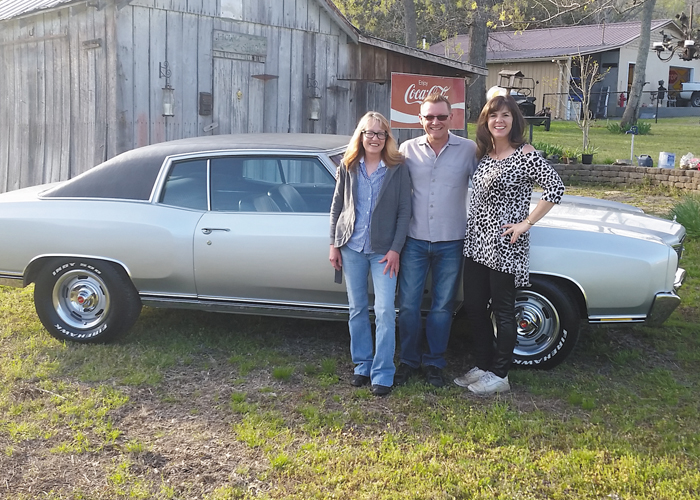
Truly a tear-jerker of a story, Lisa Lamont’s 1970 Monte Carlo, restored and customized to fabulous condition, is definitely a head-turner, wining several car shows. Before we look at Lamont’s beauty, it is necessary to look back at the Monte Carlo’s original design and production.
In the mid-1960s, Chevrolet decided to look into the personal luxury car market. Already manufacturing 12 different models and struggling to produce an answer to Ford’s Mustang, the company did not have a car to directly compete with Buick’s Riviera, Pontiac’s G-body Grand Prix, or Ford’s Thunderbird.
To fill this production void, a new car design, under the code name “Concurs,” was completed in 1969, and production of the rebranded Monte Carlo began in 1970. Borrowing some design ideas from the Cadillac Eldorado and components from the Chevrolet Chevelle, the first Monte Carlos rolled off the production lines. The new model was very successful in the affordable luxury car market, providing many options for consumers, but because of the 1970 labor strike, production numbers fell short of its goal of 185,000, only producing 159,341.
Engine options for the 1970 two-door car varied from the basic 350-cubic-inch V-8 up to the 454-cubic-inch engine, which was fitted in the SS edition. Since the car was designed and outfitted with Chevelle parts, the Monte Carlo could come with any of Chevelle’s big block engine packages in between the 350 and 454.
Purchased by 3,823 consumers in 1970, the SS454 option package included heavy duty suspension, SS454 badging on the deck lid and rocker panels, thin black rocker panel stripes, dual chrome exhaust extensions, automatic level control suspension, and 15 x 7 rally wheels with GTO-15B white stripe tires. Most of these ran the LS-5 454 engine that was rated at 350 bhp, but around 10 came rolled out of the factory with the LS-6 454 engine, which produced 450 bhp.
Lisa Lamont’s 1970 Monte Carlo was originally one of these 454-equipped ground-scorchers. However, by the time Lamont purchased it in 1995, the engine had been swapped to a modified 350 for drag-racing, and its paint was less than desirable. Lamont stated that she just needed a car, but she fell in love with the body contours and overall styling of the muscle car.
For years, the Monte Carlo was Lamont’s daily driver, making trips to work, running errands, and traveling on trips out of state. The car was also used to drive Lamont’s niece to and from school. For one of her fondest memories of the car, Lamont tells a story of when several of the children in her neighborhood wanted to ride in the car to school. One day, the kids refused to ride the bus, but instead, Lamont got approval from all of the children’s parents to take them to school. After loading five kids into the vehicle, she drove them all to school, creating a cherished memory for all “riding old school”.
Lamont continues to relate memories of the Monte Carlo covered in primer and rust; one story, in particular, involves her niece’s senior prom. Upon the request of her niece, Lamont drove her niece to her senior prom at the Opryland Hotel in the well-used car, a stark contrast to the other fine automobiles used at the event. Other prom attendees responded by asking Lamont to pick them up and drop them off at the prom as well.
The Monte Carlo was driven daily until around 2008, when Lamont moved back home to care for her mother, Clara Dean Hood. At this time, the car sat in the front yard of Hood’s house, under trees and unmoved for seven years. Over these years, Lamont, falling into bankruptcy, sacrificed her financial stability to support her mother. Lamont’s mother passed away in 2015, which left Lamont in need of money to pay final expenses.
With the car coated in tree sap and in need of restoration, Lamont initially offered to sell the automobile to her cousins, James and Julie Tucker, for a few thousand dollars. The Tuckers, with the idea of restoring the vehicle and returning it to Lamont, refused the first price; Lamont countered with $1300, a sum needed to pay lawyer fees. The Tuckers jumped on the offer. On a fishing trip at the time, James recalls phoning his wife, Julie, about the agreement and urging her to purchase the car quickly before Lamont could change her mind.
After buying the car in June 2015, it was not until early September 2015 that James Tucker pushed the Monte Carlo into his garage and began calculating all things needed for the restoration. The Tuckers, who worked for a marketing company at the time, created and circulated a letter that asked for prayers, charitable donations, and/or laborers. The two also established a secret Facebook page called “Operation Monte Carlo” that archived the automobile’s restoration and connected to other supporters. Purposefully, Lamont was blocked from access to the group to preserve her surprise-in-progress.
After organizing work days through the Facebook page, Julie recalls that people would arrive at the Tuckers’ house willing to work on the car, while others would bring food.
“So many people showed up and showed out,” she said.
Throughout the restoration process, there were a few close calls that could potentially alert Lamont to the project. The Tuckers remember having “Lisa drills” for when Lamont might arrive unannounced at the work site. Workers would scatter, block the driveway, and close the garage quickly to hide the restoration. James also recollects an incident when he had to successfully lie to Lamont after posting a revealing fact about the restoration on Facebook. Luckily, Lamont was kept unaware of the true intentions of her cousins and their co-conspirators.
The car itself was entirely restored with parts donated to the project by the Tuckers and supporters through Operation Monte Carlo. The restoration, which included overhauling the 350 cubic inch engine, was completed inside the Tuckers’ garage. To paint the car, James Tucker structured a makeshift painting booth inside his garage by hanging plastic sheeting from the ceiling.
In April 2016, Julie Tucker took Lamont to lunch to help plan a birthday party for James Tucker, and by this act of subterfuge, Lamont planned her own reveal party, which was scheduled for May 1. Over 120 people, including Tennessee State Representative Susan Lynn, attended the reveal. Lamont explains that there were attendees of the reveal she had never met, but they had contributed to the build in some way. A local television channel even produced a story about the event. The Tuckers proudly gave Lamont the keys and the title, which had been kept in Lamont’s name, to the restored Monte Carlo; with tears of joy, Lamont accepted the automobile graciously and thankfully for all those involved.
Currently, the car is a weekend cruiser. Meticulously maintained, Lamont regularly and proudly enters the vehicle into car shows and is still grateful for all the effort put into restoring her beloved Monte Carlo. •